Rethinking Intervention II
 If a young person you care about becomes involved in a behavior that will ultimately lead to destruction, it would be wise to conduct an intervention. You have the very important opportunity to intercede for the adolescents in your sphere of influence, just as Odysseus stepped into the lives of his crew. What is an intervention? When a person is addicted to their lotus of choice, the other people in her life—siblings, parents, and friends—may be experiencing a wide range of feelings, including anger, guilt, betrayal, fear, or frustration. Maybe things have been tried in the past and have failed. The situation can be chaotic. The goal of an intervention is to focus the siblings, friends, and family into a cohesive group that can introduce change into the destructive cycle of dependence. Most of us can remember when something said or done by someone who was important to us changed our way of thinking and perhaps saved us from a ruinous situation.
 The group must have a leader—an Odysseus, so to speak. The leader must make sure that the group has been familiarized with the dysfunction at hand. If the problem is an addiction, treatment options should be investigated. The intervention group should meet prior to the actual intervention for purposes of preparation. What is going to be said to the individual? Who should be involved? Treatment should be arranged ahead of time.
When the time comes for the actual intervention, the leader’s job is to establish a sense of order in the process. Each person in the group gets an opportunity to speak to the person involved and let her know how much she means and how much she is loved. The individual needs to know that her behavior affects everyone in the room and that the problem is no longer hidden. Since treatment has already been arranged, there is no room for debate. Keep the tone loving and full of respect, but be resolute. The person may break down and cry. Perhaps she will become angry. Whatever the reaction, be firm. For the individual and for the group, the problem must be resolved and not allowed to continue.
 Interventions of this kind may vary and don’t necessarily hold to a strict set of rules. Sometimes a simple intervention is best, maybe addressing a situation that hasn’t been previously acknowledged or asking a person to stop a behavior that is doing them harm or draining their life energy away. A simple intervention in an addiction to busyness can include requiring a student who is overextended to reduce the number of activities in which they are involved. For a teen that is lost in a fog of video games, television, or the Internet, it may mean taking away the game system, disconnecting the Internet, or removing the television from the bedroom. Regardless of the situation, it is highly recommended that you seek out the advice of a counselor or intervention professional for your particular situation.
 Interventions of this kind may vary and don’t necessarily hold to a strict set of rules. Sometimes a simple intervention is best, maybe addressing a situation that hasn’t been previously acknowledged or asking a person to stop a behavior that is doing them harm or draining their life energy away. A simple intervention in an addiction to busyness can include requiring a student who is overextended to reduce the number of activities in which they are involved. For a teen that is lost in a fog of video games, television, or the Internet, it may mean taking away the game system, disconnecting the Internet, or removing the television from the bedroom. Regardless of the situation, it is highly recommended that you seek out the advice of a counselor or intervention professional for your particular situation.
Labels: addiction, counselor, healing, intervention, intoxicating, Lotus, Morpheus, Odysseus, ships, teacher, Troy, wound, youth worker
posted by Jay D'Ambrosio at 11:43 AM
0 comments


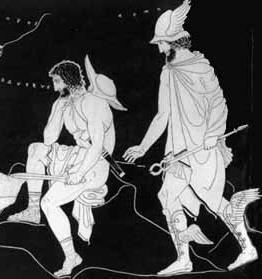 The gods sent their messenger from Mount Olympus to talk sense into Calypso and get her to free the despairing Odysseus. We adult leaders will sometimes have to intervene in an unhealthy adolescent relationship. Remember that it is important to continually invest in your own relationships with students so that when the time comes to engage their story in a meaningful way, your advice and guidance will be taken to heart and not summarily dismissed.
 Be intentional about building relationships with students. The last thing a student wants is unsolicited advice or assistance from an adult who has never bothered to get to know them. Adult relationships typically evolve over a period of time and require quite a few conversations and shared experiences before there is a willingness to be vulnerable and open. Adolescents are somewhat different in this respect. It is possible to build fairly strong relationships in a relatively short period of time.
 How was Odysseus freed from his captivity on Calypso’s island? Keep in mind, Odysseus had fallen into despair, resigning to the fact that he would never again see his cherished homeland of Ithaca. The mighty hero was in a helpless situation. Intervention had to come from outside the island, from Zeus himself. Why did the gods intervene in this situation? Because they heard the cries of Odysseus and decided to once again step into his story.
 Just as the gods noticed the tears of Odysseus, we as adult leaders need to be aware of changes in our students’ behavior. Is a normally happy and upbeat girl now depressed and teary-eyed? Is a boy who is normally talkative suddenly quiet? Is an easygoing student becoming touchy and irritable? Granted, there could be many reasons for such a change, but pay attention to who it is they are spending time with.
 If you are a teacher or school counselor, spend time in the hallways or the cafeteria. You would be amazed at what you can learn from time spent daily in the hallways between classes or in the cafeteria during lunch. If you are a coach, pay attention to what is discussed in the locker room or on the field. There you will find adolescents at their most unvarnished. Try to notice who students sit with during unstructured time. This may sound sneaky, but listen in on their conversations. Remember that this is a war for the hearts of the young people in our care! This will reveal a great deal about what is happening in their lives and give you clues as to how you can intervene in destructive relationships.
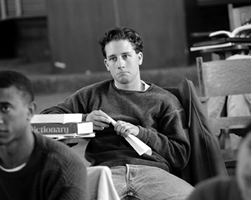 Just as the gods noticed the tears of Odysseus, we as adult leaders need to be aware of changes in our students’ behavior. Is a normally happy and upbeat girl now depressed and teary-eyed? Is a boy who is normally talkative suddenly quiet? Is an easygoing student becoming touchy and irritable? Granted, there could be many reasons for such a change, but pay attention to who it is they are spending time with.
 Manuel, a thirteen-year-old student, moved into the school district from Los Angeles halfway through the year. He was somewhat flippant about school rules, and as the year progressed, he found himself in trouble more often than not. Manuel was in and out of detention and eventually was suspended from school for a period of time. His home life was chaotic. His father had walked out on the family when he was very young, and he and his mother had lived with one relative after another over a period of several years. Furthermore, being Latino in a predominately white, suburban school wasn’t easy.
 One day they happened to have a few moments to chat—more accurately, Mr. Alfhild, like Athena, arranged for the encounter. When Manuel walked into the math classroom, Mr. Alfhild knew by the look on his face that Manuel thought he had done something wrong. He asked him to sit down. Manuel looked nervous. What happened next was a complete surprise. Mr. Alfhild told Manuel that he had been observing him for quite a while now and had noticed that he possessed many good qualities. Manuel appeared somewhat shocked that Mr. Alfhild had not brought him in to yell at him or confront him about this problem or that. Instead, Mr. Alfhild had asked Manuel to meet so that he could pay him a compliment!
 It is so important that we look for the positive things in a young person’s life. If we search for the negative, we are sure to find it. Isn’t that true about your own life as well? This can really be a challenge! We are so conditioned to seek the negative that we can completely overlook the positive in other people. Students especially need to hear us affirm the good in their lives. It is important to look beyond what a young person is right now, at this present moment, and instead see what they could become. The children look up to us and respect what we as adult leaders have to say (despite messages they may convey to the contrary). We carry an authority that comes with our position. Use it wisely!
 To an adult, this duty might have seemed like a chore. However, looking at this new role through the eyes of a middle school student is a completely different experience. What had Mr. Alfhild really given to Manuel? On the surface, a job, but remember that the gift is always a concrete demonstration of something deeper. He was giving him his trust, something no one had offered him before. Mr. Alfhild was expressing with that gift the idea that Manuel was trustworthy. He was good. He was now an “office runner,” someone to be trusted, not just a troublemaker. He had a position and a title. As Manuel began to live up to the gift that was given to him, Mr. Alfhild could tell that there were subtle changes in his demeanor. He became friendlier with other teachers in the building, and because of that, other teachers began treating him in the same manner. We teach people how to treat us, and that’s just what Manuel began to learn. At the end of the year, Mr. Alfhild gave him a certificate as an award for being an excellent office runner. It was well deserved!
 Awareness of the journey often begins when we are in a broken condition, when things are not going our way. Those broken times in our lives occur for just that purpose. They are a wake-up call. When a young person is faced with a painful trial, he is also faced with a choice—a choice between hope and despair. If he chooses despair, he will take one step further along the descending path of cynicism, unhealthy relationships, hesitation, and fear. If he chooses hope, he must acknowledge that there is something greater, that the story of his life has yet to fully unfold. This will take courage, no doubt about it, but as Goethe said, “Be bold, and mighty forces will come to your aid.”
 A few years ago, I had a thirteen-year-old student named Darcy. Darcy had faced a great deal of hardship in her young life. Her father wasn’t in the picture at all, and her mother worked three jobs just to make ends meet. Because her mother was never home, Darcy was essentially both mother and father to her two brothers, but her older brother had physically abused her, and her younger brother, though she loved him, needed more than she had to give. She had managed to get herself into quite a bit of trouble in school, by way of fights, shouting matches with teachers, and outbursts. Most likely, she had begun to agree with the voices that told her that she needed to be “tough” to survive, not to “take any crap” from anybody.
 As she tearfully told me what had happened, I suggested that she go down to the office and tell her side of the story to the principal. It was then that she said, “Mr. D, it won’t do any good. I’m the bad kid. Everybody in the school knows I’m the bad kid.” In other words, she had absorbed the message of the voices: “You’re a bad person.”
 Sensing the despair that Darcy was now feeling, I was faced with a choice. Would I simply pat her on the back and say, “Well, I’m sure everything will work out”? Or would I fight on her behalf? I chose to fight. I challenged the voice that had been labeling her “the bad kid.” I immediately reminded her of the encouragement she had given Jen in the classroom, and what that meant to Jen. At this, she smiled a little. As adults, we must understand how powerful our words are. With our words, we have the power to both hurt and heal. I said, “You see, Darcy, there really is something good and alive inside you.”