Rethinking Gifts VI
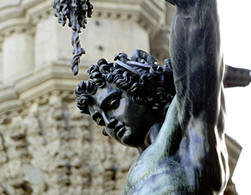 The Greek hero Perseus was sent into exile as a child by his fearful grandfather who was told by an oracle that his grandson would one day bring an end to his rule. He and his mother Danae were locked in a wooden chest and set adrift on the sea until one day they landed on the shores of the island of Seriphos. The young hero grew up on this island with no real idea of his place in the world. He was lost. He doubted himself and his ability to face the serious challenges of life.
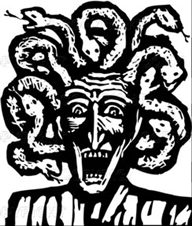 One day, the king of the island, Polydectes, demanded tribute from Perseus and his mother, a tribute that neither could afford to pay. Perseus pleaded with the king, saying that he had nothing to offer but his service. The king, seizing the opportunity, assigned to Perseus what seemed to be an impossible task: he wanted the head of the fearsome Gorgon Medusa. The Gorgons were creatures, loathed by gods and men, whose hair was comprised of venomous snakes. They possessed the chilling ability to turn those that gazed upon her hideous faces into stone.
Perseus was faced with a challenge that tested the strength of his resolve. Was he up to the challenge? Imagine the thoughts that might have gone through his mind at the time. “This is too big for me. I will fail if I try. She’ll turn me to stone like all the rest!” That is the critical moment when the goddess Athena entered the story. She too followed the mythical pattern we have described previously. Perseus encountered Athena—or perhaps we should say, Athena arranged for the meeting. She counseled the young Perseus, encouraging him with her words.
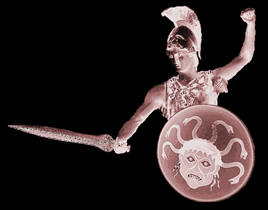 Demonstrating her faith in the young hero in a way that was very concrete, Athena gave him her very own shield, a reflective shield that would allow him to see Medusa without gazing directly at her. She further directed him where to acquire the other tools he would need to complete his quest, including a sword, a helmet of invisibility, winged sandals, and a magical bag. The young hero went forth, knowing that a goddess believed that there was something in him that was capable of accomplishing great deeds. He also carried with him the physical representation of Athena’s belief in him, the shield, sword, and other implements necessary to achieve his goal.
Labels: Athena, belief, challenge, encouragement, faith, gifts, Greek, helmet, Medusa, myth, mythology, Perseus, resolve, shield, sword, winged sandals
posted by Jay D'Ambrosio at 8:45 PM
0 comments

 Awareness of the journey often begins when we are in a broken condition, when things are not going our way. Those broken times in our lives occur for just that purpose. They are a wake-up call. When a young person is faced with a painful trial, he is also faced with a choice—a choice between hope and despair. If he chooses despair, he will take one step further along the descending path of cynicism, unhealthy relationships, hesitation, and fear. If he chooses hope, he must acknowledge that there is something greater, that the story of his life has yet to fully unfold. This will take courage, no doubt about it, but as Goethe said, “Be bold, and mighty forces will come to your aid.”
 A few years ago, I had a thirteen-year-old student named Darcy. Darcy had faced a great deal of hardship in her young life. Her father wasn’t in the picture at all, and her mother worked three jobs just to make ends meet. Because her mother was never home, Darcy was essentially both mother and father to her two brothers, but her older brother had physically abused her, and her younger brother, though she loved him, needed more than she had to give. She had managed to get herself into quite a bit of trouble in school, by way of fights, shouting matches with teachers, and outbursts. Most likely, she had begun to agree with the voices that told her that she needed to be “tough” to survive, not to “take any crap” from anybody.
 As she tearfully told me what had happened, I suggested that she go down to the office and tell her side of the story to the principal. It was then that she said, “Mr. D, it won’t do any good. I’m the bad kid. Everybody in the school knows I’m the bad kid.” In other words, she had absorbed the message of the voices: “You’re a bad person.”
 Sensing the despair that Darcy was now feeling, I was faced with a choice. Would I simply pat her on the back and say, “Well, I’m sure everything will work out”? Or would I fight on her behalf? I chose to fight. I challenged the voice that had been labeling her “the bad kid.” I immediately reminded her of the encouragement she had given Jen in the classroom, and what that meant to Jen. At this, she smiled a little. As adults, we must understand how powerful our words are. With our words, we have the power to both hurt and heal. I said, “You see, Darcy, there really is something good and alive inside you.”
 happens next? A subtle voice speaking in your mind delivers a disparaging message—a fiery dart aimed right at your heart—suggesting: