Rethinking the Lotus III
 Brittany was a high school sophomore who excelled in school. Her teachers suggested that if she continued at this level of academic performance, she would eventually become valedictorian of her graduating class. She was used to success in the classroom, but when she looked in the mirror each morning, she questioned her reasons for living. You see, Brittany had bought into the lie that deceives so many teenage girls today—the lie that you must look like the women in the fashion magazines to be considered beautiful. As she looked in the mirror, she berated herself for having a nose that seemed too large. She scoffed at her waist and legs as she turned from one side to the next, trying to see herself from all angles.
In school, Brittany walked with an air of timidity and caution, devoid of the self-confidence that attracts others. Consequently, she found that the boys in her classes didn’t seem to pay attention to her at all. This negative cycle only served to reinforce her poor opinion of herself. Her lotus fruit was soon to be discovered, however. She and her friend Diana, who was struggling with similar issues, both happened to catch an episode of a new reality TV show one night. In the cafeteria the next day, Brittany and Diana discussed at length the intricacies of the televised relationships that were forming so rapidly before their very eyes.
 Brittany was hooked. She began spending an increasing amount of time in front of the TV screen, watching every reality show she could find. Sometimes she would literally spend hours flipping through the hundreds of channels offered by her satellite service provider, looking for reality programming. Having a television in her room allowed her to stay up very late at night voyeuristically watching the lives of others. Her father began to worry about her when he noticed a drop in her grades at the midterm.
How did television become the lotus fruit for an intelligent but self-conscious high school girl? What did the reality shows offer that could lead Brittany to waste hours of her life in front of a video screen? For her, it was the opportunity to live life through the eyes of someone else. She could have the feeling of taking risks without actually taking them. All of the emotions were there—being excited and nervous on the first date, being angry at a betrayal of trust, and being happy and tearful when a relationship seemed to work out. Brittany didn’t feel confident enough to chance starting up a conversation with someone new, but it was easy to watch others do this very thing on TV.
 It is really the same effect that soap operas have had on people for generations now, except that a new dimension of reality has been stirred into the mix, creating an intoxicating blend. While she was watching them, the reality shows helped her to forget, or perhaps we should say "anesthetize," the agony of her own self-perception. Her blank stare into the expanse of the video screen might have mirrored that of the Greek sailors upon their consumption of the narcotic lotus.
 It is really the same effect that soap operas have had on people for generations now, except that a new dimension of reality has been stirred into the mix, creating an intoxicating blend. While she was watching them, the reality shows helped her to forget, or perhaps we should say "anesthetize," the agony of her own self-perception. Her blank stare into the expanse of the video screen might have mirrored that of the Greek sailors upon their consumption of the narcotic lotus.
Labels: anesthetize, betrayal, drop in grades, Greek, intoxicating, Lotus, narcotic, negative, reality tv, relationship, television
posted by Jay D'Ambrosio at 8:09 PM
0 comments

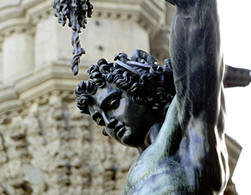 The Greek hero Perseus was sent into exile as a child by his fearful grandfather who was told by an oracle that his grandson would one day bring an end to his rule. He and his mother Danae were locked in a wooden chest and set adrift on the sea until one day they landed on the shores of the island of Seriphos. The young hero grew up on this island with no real idea of his place in the world. He was lost. He doubted himself and his ability to face the serious challenges of life.
 One day, the king of the island, Polydectes, demanded tribute from Perseus and his mother, a tribute that neither could afford to pay. Perseus pleaded with the king, saying that he had nothing to offer but his service. The king, seizing the opportunity, assigned to Perseus what seemed to be an impossible task: he wanted the head of the fearsome Gorgon Medusa. The Gorgons were creatures, loathed by gods and men, whose hair was comprised of venomous snakes. They possessed the chilling ability to turn those that gazed upon her hideous faces into stone.
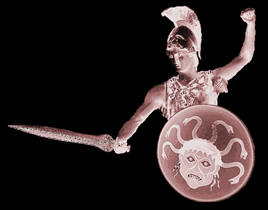 Demonstrating her faith in the young hero in a way that was very concrete, Athena gave him her very own shield, a reflective shield that would allow him to see Medusa without gazing directly at her. She further directed him where to acquire the other tools he would need to complete his quest, including a sword, a helmet of invisibility, winged sandals, and a magical bag. The young hero went forth, knowing that a goddess believed that there was something in him that was capable of accomplishing great deeds. He also carried with him the physical representation of Athena’s belief in him, the shield, sword, and other implements necessary to achieve his goal.