Rethinking What Might Have Been
 The first ghost that appeared to Odysseus was that of one of his own sailors, Elpenor, who had died when he fell off the roof of Circe’s palace. He spoke regretfully of the drunken state that had caused him to stumble and fall to his doom. Elpenor entreated Odysseus to give him a proper burial lest his spirit torment the king’s days and haunt his steps. Odysseus swore an oath to provide a suitable wake for his fallen comrade.
If we think about Elpenor’s words, we see that his ghost was full of regret over what might have been. When someone dies in their own world, especially a classmate, it is very common for young people to feel great sorrow and regret over the opportunities they missed to interact with the deceased. These thoughts and emotions can swirl around inside a student and preoccupy their waking hours. The goblins with which we as adult leaders must do battle are known as Regret and Depression.
 One of the best ways to help a student in this situation is to give him the opportunity to share his thoughts and feelings, either in a group of his similarly grieving peers or one-on-one with an adult leader. If not given the chance to be freely expressed, these emotions and thoughts can reach a boiling point and cause some serious problems in a young person’s life. Sharing in this manner allows a student the chance to give substance to his feelings and to put words to otherwise amorphous laments and sorrows. Steps should be taken to ascertain who the close friends of the deceased were so that the group can freely share personal memories and stories. These are some ways in which we can help students to slay the monster Regret.
Depression can be defeated through encouraging a grieving student to make forward progress. Suggest new activities in which the young person can become involved. Motivate the student’s friends to come around her during this time. Service projects can be an excellent way to move the student who is sinking into the mire of depression to look beyond her own struggles and toward meeting the needs of others.
What in your life do you regret doing? What do you regret not doing? What changes can you make right now so that you can live your life without regrets?
Labels: Circe, depression, friendship, ghosts, motivate, Odysseus, regret, service, sorrow
posted by Jay D'Ambrosio at 7:44 PM
0 comments

 William Shakespeare warns us about the dangers of young “love” in his play Romeo and Juliet. He tells the story of two young people who fall in love in the midst of a war between their families. Romeo is a Montague, while Juliet is a Capulet. They chase each other with a passion, but in the end, their unrelenting infatuation leads to their demise.
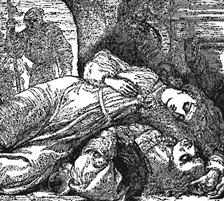 The star-crossed lovers believed that the answers they sought could be found in the other person. When Romeo believed that Juliet had died, he ended his own life. When Juliet awoke from her deathlike sleep, she committed suicide after realizing that Romeo had taken his life. This play is rightly described as a tragedy! How many adolescent suicides, bouts of depression, and insecurities today are related to lost love, and to the perception that the answers to life’s questions and the source of healing have been lost?
 Teenage relationships that are passionate, move fast, and lead to heartache and ruin. Just as Odysseus washed ashore on the island of Calypso, wounded and in pain, many adolescents run to the arms of the opposite sex for solace, a shelter in the midst of life’s storms. In essence, they end up seeking answers to their heart’s deep questions in another person. This is a recipe for disaster.
  The way adolescent boys end up running to girls as their source of healing and life’s answers can look a little different. A teenage boy may become subservient to a girl, catering to her every whim, just as Odysseus was made prisoner to Calypso. The girl may become more demanding and bossy and begin to look down upon her boyfriend for his neediness and lack of courage to stand up to her. This is typically because what drew her to the boy in the first place was his strong, untamed nature. Deep down, she isn’t looking for someone who needs her, she is hoping for someone who wants her. This may appear to be a subtle difference, but it is very significant. She will push and push, actually hoping to prod the boy into standing up to her demands. This may sound odd, but it occurs frequently.
 Just as the gods noticed the tears of Odysseus, we as adult leaders need to be aware of changes in our students’ behavior. Is a normally happy and upbeat girl now depressed and teary-eyed? Is a boy who is normally talkative suddenly quiet? Is an easygoing student becoming touchy and irritable? Granted, there could be many reasons for such a change, but pay attention to who it is they are spending time with.
 Adolescents often verbalize those statements that they’ve agreed with, declaring that they are “unlucky” or “dumb.” It would be easy to dismiss those sentiments as nothing more than teen angst, but let’s look at what is really happening on a deeper level. For example, if Danielle is spurned by a boy that she really likes, she might be presented with the lie that she is “unlovable” or “unattractive.” If she, in her mind and heart, agrees with this assessment—however absurd—she will begin to behave as if she were unlovable or unattractive. This behavior in turn will invite others to treat her in the same way. In essence, we teach others how to treat us. When Danielle hears these messages from both herself and others around her, she may be tempted to evaluate other situations in her life through the same discouraging lens.
 happens next? A subtle voice speaking in your mind delivers a disparaging message—a fiery dart aimed right at your heart—suggesting: