Rethinking Love III
 William Shakespeare warns us about the dangers of young “love” in his play Romeo and Juliet. He tells the story of two young people who fall in love in the midst of a war between their families. Romeo is a Montague, while Juliet is a Capulet. They chase each other with a passion, but in the end, their unrelenting infatuation leads to their demise.
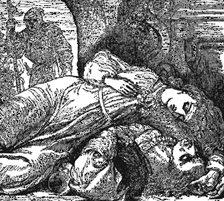 The star-crossed lovers believed that the answers they sought could be found in the other person. When Romeo believed that Juliet had died, he ended his own life. When Juliet awoke from her deathlike sleep, she committed suicide after realizing that Romeo had taken his life. This play is rightly described as a tragedy! How many adolescent suicides, bouts of depression, and insecurities today are related to lost love, and to the perception that the answers to life’s questions and the source of healing have been lost?
Our culture doesn’t help much. Music videos, video games, television, and the Internet all scream sex. Flip through your television channels. Look at the advertising schemes. What is held up as the ultimate meaning of life? Romantic relationships and physical intimacy! Don’t get me wrong, for those who have had relationships like these, they are wonderful things. They are designed to bring people closer together. But to make these things the object of our quest and our reason for living is to set ourselves up for failure and heartache.
We are in a position to help adolescents navigate through these murky relational waters. There are probably some of you who are thinking that you would never be able to advise a student with issues such as these. You may feel that you don’t have your own act together, so you don’t see how can you possibly help someone else. Don’t worry! Having your life in perfect order is not a prerequisite for helping others.
Labels: Calypso, confusion, depression, insecurities, Juliet, love, Odysseus, passion, relationships, Romeo, sex, Shakespeare, teenage, violence
posted by Jay D'Ambrosio at 6:51 AM
0 comments

 Teenage relationships that are passionate, move fast, and lead to heartache and ruin. Just as Odysseus washed ashore on the island of Calypso, wounded and in pain, many adolescents run to the arms of the opposite sex for solace, a shelter in the midst of life’s storms. In essence, they end up seeking answers to their heart’s deep questions in another person. This is a recipe for disaster.
 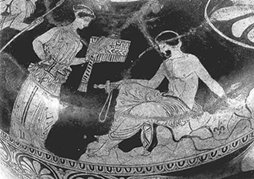 The way adolescent boys end up running to girls as their source of healing and life’s answers can look a little different. A teenage boy may become subservient to a girl, catering to her every whim, just as Odysseus was made prisoner to Calypso. The girl may become more demanding and bossy and begin to look down upon her boyfriend for his neediness and lack of courage to stand up to her. This is typically because what drew her to the boy in the first place was his strong, untamed nature. Deep down, she isn’t looking for someone who needs her, she is hoping for someone who wants her. This may appear to be a subtle difference, but it is very significant. She will push and push, actually hoping to prod the boy into standing up to her demands. This may sound odd, but it occurs frequently.
 Odysseus, drifting in an endless sea of despair, washed ashore on an unknown island. All he understood was that his face was against the rough, grainy sand of a beach, and that he was for the moment safe from Poseidon’s apparently unyielding wrath. His vision skewed due to lack of sleep and his taxing ordeal, he came upon a shimmering apparition. He asked this strange being where he had landed. With voice enticing, she assured him that he was now home. Feeling the hope arise in his heart, the hero supposed that he had arrived in Ithaca; however, he was very much mistaken, for he had actually landed on the island of the sea nymph, Calypso.
 Homer tells us that this intoxicating divinity had fallen in love with the mortal Odysseus. The poet gives us no indication that this love wasn’t the real thing. Calypso passionately loved Odysseus. Nonetheless, he knew that his fate lay along another path. His heart's longing was for his true home and for his family. The sea nymph’s tidal passion for Odysseus caused her to, in essence, imprison him on her island. Being battered and faint from his horrendous trials, the hero collapsed into the loving embrace of Calypso.
 The gods of Olympus heard the cries of the hero-king and, considering his destiny, sent the messenger-god to the island prison. Hermes came to Calypso and relayed the will of Zeus. He declared that Odysseus was to be set free from the bonds of this island and was to be permitted to continue his quest. Embittered by this word from on high, Calypso protested. Finally, Hermes warned the goddess that dire consequences drive her island to the bottom of Poseidon's sea if she insisted on keeping Odysseus captive. Calypso relented at last, and Odysseus was free to journey on!
 Teens today have been wounded in a variety of ways. They are hurting. Outwardly, things may seem fine, but below the waters, there is a immense private suffering. Look at our society. What is put forth as the solution to our problems and our pain? It's romantic love, isn't it? Watch a few TV shows. The shows aimed at young people portray the main character trying to get a boyfriend or girlfriend. No doubt, it can be entertaining, but it won’t make things right in the world. Commercials communicate the same message. “Wear this deodorant and you’ll have to fight the girls off!” “Try this shampoo and the boys will flock to your side!” There are so many messages in our culture that sear the idea into the minds of adolescents that if you find the right person, it will make everything all right.
 Here is another great quote from Henri Nouwen: