Rethinking the Lotus
Does the lotus fruit exist in our society today? Absolutely! What sorts of things act as an anesthetic for the wounds of life? Let’s take a look at an example.
Video Games: The Story of Trent
 By the time Trent had reached middle school, he knew beyond a shadow of a doubt that he would have a difficult row to hoe. He was fairly overweight, and to say that he had a poor complexion would have been an understatement. If you were to make an honest assessment of the situation, you would see that Trent had only one or two friends (if you could call them that) in the whole school. Each day, he awoke with a sickening feeling in his gut, knowing the teasing and tormenting that awaited him upon his arrival to school. “Fat ass!” “Pizza face!” “Wide load!” He tried to ignore the comments as his parents had suggested, but deep down, each unkind word cut deep into his heart. His parents were very loving and did the best they could, but the fiery words of his peers did their damage with alarming precision. The enemy was driving a spear deeper and deeper into Trent’s soul.
 This newfound activity was a fantasy adventure game that involved some pretty graphic violence. Trent found himself wanting to spend more and more time playing the game, rather than doing other things in the “real world.” His parents soon noticed that he was spending no fewer than five hours every day playing this game and was interacting with his family less and less. At dinnertime, his mother, father, and older sister would take turns trying to start discussions with Trent about things at school or his life in general, but he didn’t have much to say, for his life was beginning to revolve around the game and the fantasy characters that inhabited this virtual world.
Why did a video game become the lotus fruit to this lonely and hurting middle school student? What was the draw—the narcotic effect, if you will? Well, it offered Trent an escape from the reality that was so painful each day. In the real world, he was overweight, had a bad acne problem, and was teased constantly. However, in the virtual world of the game, he was a gun-toting mercenary named Zax, feared and respected by all races throughout the galaxy.
 What did the video game offer that reality did not? During the hours that he played the game, Trent could forget about the painful reality he faced day in and day out. The game was, in essence, an opiate. It offered the feeling of power and courage without really requiring anything of him. He was willing to take incredible risks as Zax, such as single-handedly infiltrating the orbiting battle station of an alien invasion force. In real life, meanwhile, Trent rarely took risks and avoided situations where he was sure to be harassed, such as school dances, rest rooms, and stairwells. The game also offered him the illusion of something that is deep in the heart of every boy: adventure and the chance to play the hero. A recent study publicized by BBC News found that nearly a third of all students were playing video games daily, and that close to 10 percent played for at least thirty hours each week! In this example, Trent found himself acting more and more like the entranced lotus-eaters of Homeric epic.
Video Games: The Story of Trent
 By the time Trent had reached middle school, he knew beyond a shadow of a doubt that he would have a difficult row to hoe. He was fairly overweight, and to say that he had a poor complexion would have been an understatement. If you were to make an honest assessment of the situation, you would see that Trent had only one or two friends (if you could call them that) in the whole school. Each day, he awoke with a sickening feeling in his gut, knowing the teasing and tormenting that awaited him upon his arrival to school. “Fat ass!” “Pizza face!” “Wide load!” He tried to ignore the comments as his parents had suggested, but deep down, each unkind word cut deep into his heart. His parents were very loving and did the best they could, but the fiery words of his peers did their damage with alarming precision. The enemy was driving a spear deeper and deeper into Trent’s soul.
Trent began to come up with reasons why he just couldn’t go to school in the morning. Sometimes he felt a severe headache coming on, while other times he forced himself to vomit so that his parents wouldn’t make him get on the bus. He started spending more and more time on the Internet, chatting with others online. Some of these new online “friends” introduced Trent to a multiplayer video game in which they were participants.
 This newfound activity was a fantasy adventure game that involved some pretty graphic violence. Trent found himself wanting to spend more and more time playing the game, rather than doing other things in the “real world.” His parents soon noticed that he was spending no fewer than five hours every day playing this game and was interacting with his family less and less. At dinnertime, his mother, father, and older sister would take turns trying to start discussions with Trent about things at school or his life in general, but he didn’t have much to say, for his life was beginning to revolve around the game and the fantasy characters that inhabited this virtual world.
Why did a video game become the lotus fruit to this lonely and hurting middle school student? What was the draw—the narcotic effect, if you will? Well, it offered Trent an escape from the reality that was so painful each day. In the real world, he was overweight, had a bad acne problem, and was teased constantly. However, in the virtual world of the game, he was a gun-toting mercenary named Zax, feared and respected by all races throughout the galaxy.
 What did the video game offer that reality did not? During the hours that he played the game, Trent could forget about the painful reality he faced day in and day out. The game was, in essence, an opiate. It offered the feeling of power and courage without really requiring anything of him. He was willing to take incredible risks as Zax, such as single-handedly infiltrating the orbiting battle station of an alien invasion force. In real life, meanwhile, Trent rarely took risks and avoided situations where he was sure to be harassed, such as school dances, rest rooms, and stairwells. The game also offered him the illusion of something that is deep in the heart of every boy: adventure and the chance to play the hero. A recent study publicized by BBC News found that nearly a third of all students were playing video games daily, and that close to 10 percent played for at least thirty hours each week! In this example, Trent found himself acting more and more like the entranced lotus-eaters of Homeric epic.
Labels: alien, friendship, insults, Lotus, narcotic, online, opiate, power, video games, violence, virtual world
posted by Jay D'Ambrosio at 6:51 AM
0 comments

 William Shakespeare warns us about the dangers of young “love” in his play Romeo and Juliet. He tells the story of two young people who fall in love in the midst of a war between their families. Romeo is a Montague, while Juliet is a Capulet. They chase each other with a passion, but in the end, their unrelenting infatuation leads to their demise.
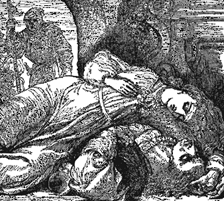 The star-crossed lovers believed that the answers they sought could be found in the other person. When Romeo believed that Juliet had died, he ended his own life. When Juliet awoke from her deathlike sleep, she committed suicide after realizing that Romeo had taken his life. This play is rightly described as a tragedy! How many adolescent suicides, bouts of depression, and insecurities today are related to lost love, and to the perception that the answers to life’s questions and the source of healing have been lost?
 Teenage relationships that are passionate, move fast, and lead to heartache and ruin. Just as Odysseus washed ashore on the island of Calypso, wounded and in pain, many adolescents run to the arms of the opposite sex for solace, a shelter in the midst of life’s storms. In essence, they end up seeking answers to their heart’s deep questions in another person. This is a recipe for disaster.
 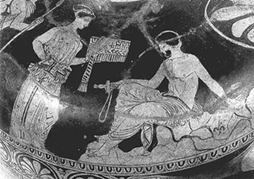 The way adolescent boys end up running to girls as their source of healing and life’s answers can look a little different. A teenage boy may become subservient to a girl, catering to her every whim, just as Odysseus was made prisoner to Calypso. The girl may become more demanding and bossy and begin to look down upon her boyfriend for his neediness and lack of courage to stand up to her. This is typically because what drew her to the boy in the first place was his strong, untamed nature. Deep down, she isn’t looking for someone who needs her, she is hoping for someone who wants her. This may appear to be a subtle difference, but it is very significant. She will push and push, actually hoping to prod the boy into standing up to her demands. This may sound odd, but it occurs frequently.