Rethinking Fears
 Fearing for Loved Ones
The mighty prophet Teiresias at last revealed himself to Odysseus and drank his fill of the spilled blood. The prophet provided his counsel, cautioning that Poseidon’s anger had yet to be assuaged. He predicted that Odysseus would lose the whole of his crew, along with his ship, to the terrors of the sea and would return alone to shores of Ithaca. There, Teiresias declared, he would realize that the men of Ithaca who wanted to marry his wife Penelope had overrun his home, devoured all sustenance, and abused his son. Hearing this declaration by the sightless oracle, Odysseus was awash with fear—the fear of losing those he held most dear to his heart.
Fear and Dread are the ogres that often haunt the steps of the adolescent who becomes brutally aware of the mortality of loved ones. Those who care about students such as these must learn to smite such foes. They are enemies who would attempt to ensnare a life that could be lived in freedom.

When disaster strikes someone close to us, it is natural to feel worried about others that we love. The sudden realization that all human beings are mortal can be very unnerving for a young person. Thoughts such as “Will my mother die?” or “Will my brother be hurt?” can cross an adolescent’s mind with startling frequency. A student affected by another’s death may appear to be fine on the outside, but inside they are often grieving. They are fearful of experiencing this type of loss again in perhaps an even more personal and devastating way.
 If you suspect that a young person is struggling with fears such as this, it is helpful to arrange for a private meeting. There, in an environment of caring and confidentiality, the student can share what is really on his mind. Allow the student to share with little input from you. Simply listen. Sometimes the best thing we can do for a young person in this situation is to be a listening ear.
If she is reluctant to divulge her thoughts concerning her fears and worries about the future, you may want to ask her to write her concerns on a piece of paper or in a journal. This is another grounding technique that allows an individual to take an abstract and thus powerful fear and make it concrete and tangible. Writing reduces intangible fears to something that is manageable. The student can look at the list and say, “So this is what I’m afraid of.” The rational mind is allowed to intervene and determine if the fears are worth having or if they are in fact irrational. A piece of paper and a pencil seem innocuous, but they are in reality very strong weapons against Fear and Dread. The pen is mightier than the sword. It is true that we will all lose those we love, but a life lived in fear of such loss is no life at all.
 If you suspect that a young person is struggling with fears such as this, it is helpful to arrange for a private meeting. There, in an environment of caring and confidentiality, the student can share what is really on his mind. Allow the student to share with little input from you. Simply listen. Sometimes the best thing we can do for a young person in this situation is to be a listening ear.
If she is reluctant to divulge her thoughts concerning her fears and worries about the future, you may want to ask her to write her concerns on a piece of paper or in a journal. This is another grounding technique that allows an individual to take an abstract and thus powerful fear and make it concrete and tangible. Writing reduces intangible fears to something that is manageable. The student can look at the list and say, “So this is what I’m afraid of.” The rational mind is allowed to intervene and determine if the fears are worth having or if they are in fact irrational. A piece of paper and a pencil seem innocuous, but they are in reality very strong weapons against Fear and Dread. The pen is mightier than the sword. It is true that we will all lose those we love, but a life lived in fear of such loss is no life at all.
Labels: dread, fear, freedom, mortality, Odysseus, Poseidon, Teiresias
posted by Jay D'Ambrosio at 9:01 AM
0 comments

 Odysseus, drifting in an endless sea of despair, washed ashore on an unknown island. All he understood was that his face was against the rough, grainy sand of a beach, and that he was for the moment safe from Poseidon’s apparently unyielding wrath. His vision skewed due to lack of sleep and his taxing ordeal, he came upon a shimmering apparition. He asked this strange being where he had landed. With voice enticing, she assured him that he was now home. Feeling the hope arise in his heart, the hero supposed that he had arrived in Ithaca; however, he was very much mistaken, for he had actually landed on the island of the sea nymph, Calypso.
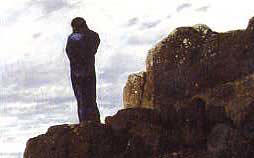 Homer tells us that this intoxicating divinity had fallen in love with the mortal Odysseus. The poet gives us no indication that this love wasn’t the real thing. Calypso passionately loved Odysseus. Nonetheless, he knew that his fate lay along another path. His heart's longing was for his true home and for his family. The sea nymph’s tidal passion for Odysseus caused her to, in essence, imprison him on her island. Being battered and faint from his horrendous trials, the hero collapsed into the loving embrace of Calypso.
 The gods of Olympus heard the cries of the hero-king and, considering his destiny, sent the messenger-god to the island prison. Hermes came to Calypso and relayed the will of Zeus. He declared that Odysseus was to be set free from the bonds of this island and was to be permitted to continue his quest. Embittered by this word from on high, Calypso protested. Finally, Hermes warned the goddess that dire consequences drive her island to the bottom of Poseidon's sea if she insisted on keeping Odysseus captive. Calypso relented at last, and Odysseus was free to journey on!