Rethinking the Lotus II
 Barry was a high school senior who was well liked by his parents, peers, and teachers. He was a solid basketball player and had already been accepted at George Washington University. His life did have its challenges, however. His father, who was respected in the community, had spent precious little time with Barry as he was growing up. He had come up with any number of excuses throughout the years as to why he was unable to take Barry camping or even play catch in the backyard. Intellectually, Barry had grown to accept this lack of interaction as normal, but his heart refused to go along. Something was missing in all of this.
 After basketball practice, Barry would typically go to his room and surf the Internet for hours. He was drawn to the possibilities that the Web offered the endless array of information and stimulation. Often, he would log in to the instant messenger and communicate for hours, sharing intimate details with complete strangers. Here was intimacy without strings attached. Frequently, Barry would search through a variety of Web sites, finding more “eye candy” than the mind could fathom. He began going to sleep later and later at night, as his online activities began to absorb more and more of his time. His basketball coach noticed that he seemed increasingly lethargic on the court, and his grades began to drop. The cyber-lotus fruit of the Internet had done its work well. Barry had numbed the pain of his missing years with his father, and he was now lost in a fog of chat rooms and virtual worlds.
Labels: addiction, Barry, coach, cyber, father, internet, Lotus, pain
posted by Jay D'Ambrosio at 6:43 AM
0 comments

 This is the point in the story where the villain of our hearts often fires back with lies and distortions that can make us wonder why we ever hoped for anything better in the first place. Like Telemachus, we too have felt the wounds of our hearts begin to throb. The enemy of the prince’s heart began to whisper, “You’ve heard this all before and paid dearly for it! Your father may have had courage, yes, but look where he is now, at the bottom of the sea. The suitors are too many and too strong for you! Don’t be a fool!”
 Upon being granted an audience with Menelaus, Telemachus concealed his true identity as prince of Ithaca, while the king remembered old battles and the fall of Troy. The Spartan monarch revealed the heroism and valor of Odysseus—and what he believed to be the fate of Odysseus, declaring his belief that the clever hero rested at the bottom of Poseidon’s sea. However, Menelaus did not stop there. What he did next proved to be crucial to the heart and soul of the young Telemachus. Menelaus correctly ascertained the identity of this mysterious visitor to his court and acknowledged that he saw a strong resemblance between Telemachus and his father.
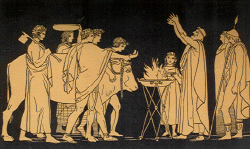 Telemachus bore a heavy burden. His father was rumored to have been lost at sea following the war at Troy, and men from his own town had invaded his home, demanding the hand of his lonely mother in marriage. This young man was the son of a king—and not just any king, mind you, but the legendary Odysseus. Despite being raised as royalty, daily being hailed as “Prince Telemachus,” this young man felt powerless in the face of the older suitors who had aggressively pushed their way into his home.