Rethinking Life After Death
 Life Continues
As the ghosts in Hades presented themselves to Odysseus, one in particular stood out from the rest. It was his mother, Anticlea. There, in the land of the dead, Odysseus finally realized that he had been absent from his family’s life for nearly fifteen years. The grief gripped him in a powerful way. He inquired of his mother the condition of his home in Ithaca and of his wife and son. He had a strong desire to know how his father was faring and the manner of his mother’s death. As his mother relayed the news from home, the Greek king fell into agony, understanding that to his family he was thought dead and that he had missed out on much of life.
When we stop to visit the graves of the loved ones that have passed on before us, it is difficult not to consider the living we have done since their passing. Births, graduations, marriages, and other major life events come and go, with the deceased individual apparently missing it all. This can provoke very powerful feelings of sorrow in those who are still here. It is no different for adolescents who lose someone special.
A student who loses a beloved grandmother, for instance, might have a difficult time around holidays, knowing that life’s customs and traditions are taking place without her presence. Another, experiencing the death of a close friend, may struggle with feelings of grief or guilt after winning an important basketball game. A teen whose mother has died could experience serious emotional pain during her senior prom, knowing that her mother would have loved to see the color and style of her prom dress. The dragon that stalks all these students, constantly struggling with the things they know their loved one is missing, is known as Despair.
How can we work with students who are grieving because they have come to the realization that their lives are continuing without the presence of someone they loved? What can make a difference in their lives?
One of the most crucial things we can do is to pay attention to the student who has lost someone special. Watch their behavior and interaction with other students, especially around times of the year and during events that may have been significant to the one that died. Does the student seem sad or cry easily? Is he unusually irritable or angry toward his friends? Do you notice that he is quiet, almost trying to disappear? These can all be clues as to the inner conflicts of the heart.
 If you should happen to become aware of such changes in behavior or attitude, address it as soon as possible. Be a listening ear if students are comfortable discussing their struggles with you. Sometimes simply talking about the feelings one is experiencing can be very cathartic.
 Art therapy works well in grieving situations, as well. Try having a student draw the things they wish the person who died could have experienced. Writing a letter to the deceased, describing what they have missed, can be very freeing to the young person who is grieving. Letters or artwork can be placed at the gravesite or similar memorial. Be creative. Try to empathize with the adolescent—put yourself in their shoes. The dragon of Despair would want a young heart to wrestle with these issues alone and in isolation. This beast can be slain by affording students an opportunity to share their pain with others, thus ultimately freeing the spirit to begin living again.
Odysseus, still in Hades, met his old ally Achilles, the mightiest of the Greek warriors. The hero, now a resident of the underworld, asked Odysseus for news of his family and whether or not his name was still remembered in the lands of Greece. Odysseus could not supply him with this information, but he was able to tell the ghost the tale of his son, Neoptolemus, and his heroic endeavors on the field of battle. Upon hearing this news, the great Achilles swelled with pride and went off along a meadow, now at peace.
Labels: art therapy, death, despair, dragon, grief, Odysseus, Penelope, renewal, writing
posted by Jay D'Ambrosio at 1:52 PM
0 comments


 If you had asked him what his interests and hobbies were, he probably wouldn’t have been able to tell you much. His heart was in pain, though on the outside it really wasn’t observable. One day, a new student arrived at his lunch table, bearing news of enticing lotus fruit. His name was Gordon, and he was what the teachers and administrators would refer to as a “problem child.” He was open about the fact that he frequently used marijuana and would share stories of being high with the others at the lunch table. Intrigued, Terry began spending more time around Gordon, eventually riding the bus to his house after school one day. It was there that Terry first experimented with pot. He and Gordon began riding their dirt bikes to the middle of the woods. There they would “light up” after school. His mother, in a haze of alcohol, would rarely say anything to Terry about not coming home from school until hours after it had already ended. He would spray down his clothes with deodorant to cover up the scent of the smoke.

 I am poured out like water, and all my bones are out of joint. My heart has turned to wax; it has melted away within me. My strength is dried up like a potsherd, and my tongue sticks to the roof of my mouth; you lay me in the dust of death. Dogs have surrounded me; a band of evil men has encircled me, they have pierced my hands and my feet. Psalm 22:14-16
 Throughout the millennia, human beings have developed a mythos around the seemingly impossible hope of resurrection. It is a brave hope, a desire to overcome the ever nearing reality of the grave. The Sumerians who created the world's first civilization told the story of Dumuzi, a fertility god who was carried off to the underworld during the hot Summer months, only to rise again at the autumnal equinox. The mythology of the Egyptians describe the brutal murder of Osiris, his descent to the underworld, and his eventual resurrection and establishment of the god of afterlife. The Greeks held that Dionysus experienced a resurrection of sorts, as did the Persian Mithras. Polynesian legends speak of a divine eel that gave up its life, only to rise again as a coconut tree so that the islanders would be provided with sustenance.
 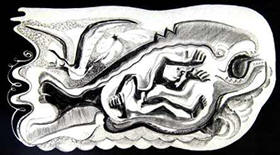 The entombment of Christ is often compared metaphorically with an earlier biblical story, that of Jonah. In the book of Jonah, the prophet is swallowed by a whale due to his refusal to obey God. What is the significance of Jonah in the belly of the whale? Well, the belly is where digestion takes place. One substance is destroyed, broken down, and through this transformation, the substance is converted to energy. The tomb in ancient times was viewed in much the same way. The term "sarcophagus" literally means "flesh eater" because what was temporal wasted away in the tomb.
 When the disciples of Jesus went to his tomb early Sunday morning, they found it empty. He had risen. Death had been overcome. Likewise, Jonah was vomited out on the shore, a changed man. The belly of the whale had digested the old self and had created a new man. The resurrection of Jesus pierced the veil that separated the temporal and the eternal, creating a way for humanity to partake in the same transformation that poets, prophets, storytellers, and nature itself expressed in epics, oracles, and the germinating seed.
  One night, after we had put our son to bed, my wife and I watched the movie The Lord of the Rings: The Fellowship of the Ring (2001). I have always been a strong admirer of J. R. R. Tolkien, due to the universal messages of truth that can be found throughout his works, and as I watched the scene in the movie where the Lord of the Nazgul stabbed the young hobbit Frodo, I began to feel as if I needed to pay close attention. In the scene, Sam, Merry, Pippin, and Aragorn watch helplessly as Frodo slips further and further into unconsciousness and toward death.
 some of the trials that befell us during those school years would be things that we wish we could forget. Let’s face it, growing up is hard! We have all seen our share of heartache, harassment, the loss friendship, isolation, divorce, death, humiliation, and pressure—if not in our own story, then at least in the stories of our friends and loved ones. Some try to shrug it off, saying that this is all just a part of adolescence, and that the kids will “get over it.” But many of you have witnessed these ordeals firsthand . . . and many have never gotten over it. The wounds they have endured in those years of life have stayed with them, like a cancer on the soul. One man I was mentoring finally confessed to me after several months that the tormenting he endured in eighth grade at the hands of a few bullies has played a huge part in his current struggle with anger issues.